What is porn-induced erectile dysfunction (PIED) and can it be reversed?
Millions of men under 40 are experiencing erectile dysfunction not because of low testosterone or a medical problem but because of how porn has rewired their brains. Here's exactly what's happening, and how to fix it.
What Exactly Is PIED? And Why Is No One Talking About It?
Let's start with the uncomfortable truth: erectile dysfunction in young, healthy men has exploded over the last two decades. And the timeline lines up almost perfectly with the mainstream adoption of high-speed internet and free streaming porn.
PIED; Porn-Induced Erectile Dysfunction — is a condition where a man can get and maintain an erection while watching pornography, but struggles or fails to do so during real sexual encounters with a partner. It's not a blood flow problem. It's not hormonal. It's not aging. It's neurological and it's driven by how the brain responds to superstimulation.
📄Research Citation
A 2014 study published in Psychology Today and widely cited in urology literature found that rates of sexual dysfunction in men aged 18–40 had risen dramatically since the early 2000s, with researchers explicitly linking increased pornography consumption to symptoms of sexual arousal disorder and erectile dysfunction in otherwise healthy young men.
Bronner, G. & Ben-Zion, I.Z. (2014). Unusual masturbatory practice as an etiological factor in the diagnosis and treatment of sexual dysfunction in young men. Journal of Sexual Medicine.
Before the internet, erectile dysfunction in men under 40 was so rare it was barely studied. Today it fills urology waiting rooms. And while the medical community has been slow to name porn as a cause, the neuroscience has been catching up fast.
The brain doesn't know the difference between pixels and a real partner. It just knows what level of stimulation it has been conditioned to expect.
— Gary Wilson, author of "Your Brain on Porn" (2014)
The Brain Science Behind PIED — Explained Simply
This is the part most articles skip, so let's actually go through it. Understanding the mechanism is what makes recovery feel logical instead of hopeful.
The dopamine system: your brain's reward engine
Dopamine is not the "pleasure" chemical — that's a common misconception. Dopamine is the "wanting" chemical. It drives motivation, craving, and pursuit. You get a hit of dopamine in anticipation of a reward, not just during it.
During sexual activity — real or pornographic — the brain releases dopamine, along with opioids (for pleasure) and oxytocin (for bonding). This system evolved to motivate us toward sex and reproduction. It works beautifully in a natural context.
Pornography hijacks this system by providing something no natural environment ever could: infinite novelty, zero rejection, and escalating stimulation on demand.
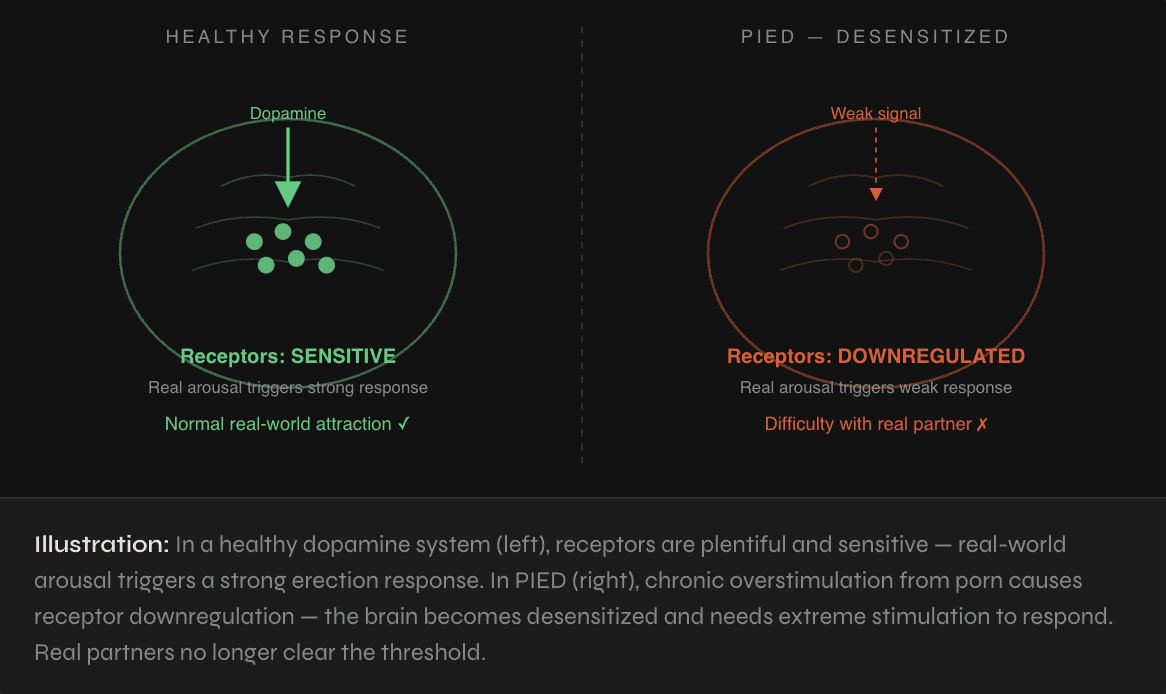
What downregulation actually means
When your brain is flooded with dopamine repeatedly — through porn — it protects itself by reducing the number and sensitivity of dopamine receptors. This is called downregulation. The same mechanism that causes drug tolerance.
The consequence: your dopamine system now requires more stimulation to produce the same response. Normal stimuli — including a real, attractive partner — no longer clear the activation threshold needed to trigger and maintain an erection.
Meanwhile, porn — with its novelty, extremity, and variety — still does. This is why men with PIED can often masturbate perfectly well to pornography but fail with a real partner. It's not anxiety (though anxiety can compound it). It's a conditioned neurological response.
📄Research Citation
Cambridge University researchers (Voon et al., 2014) used fMRI brain imaging to compare compulsive pornography users to non-users. They found that the same brain regions activated by drug cues in addicts — the ventral striatum, anterior cingulate cortex, and amygdala — were activated by pornographic imagery in heavy porn users. The patterns were nearly identical to cocaine addiction responses.
Voon, V. et al. (2014). Neural correlates of sexual cue reactivity in individuals with and without compulsive sexual behaviours. PLOS ONE, 9(7).
📄Research Citation
A 2016 review in Behavioral Sciences by researchers Hilton and Watts documented that excessive pornography use causes measurable brain changes consistent with other addictive disorders, including hypofrontality (reduced activity in the prefrontal cortex, responsible for impulse control) and altered dopamine signaling in the reward pathways.
Hilton, D.L. & Watts, C. (2011). Pornography addiction: A neuroscience perspective. Surgical Neurology International, 2(1), 19.
Signs You Might Have PIED — Be Honest With Yourself
PIED exists on a spectrum. Here are the most telling indicators — ranging from early warning signs to full-blown PIED.
01. You need porn (or porn fantasy) to finish during sex
You're physically present with a real partner, but mentally you've retreated to pornographic imagery to maintain arousal or reach orgasm. This is one of the earliest signs of desensitization.
02. Death grip and escalation dependency
You've conditioned yourself to a specific type and intensity of stimulation — often a very tight grip during masturbation — that no real encounter can replicate. You also find yourself seeking more extreme content to feel the same response.
03. Erections with porn, problems without it
The clearest diagnostic sign. You have no physical difficulty achieving erections during pornography use, but struggle or fail during real intimacy. If this is you, PIED is the most likely explanation — not cardiovascular issues, not low testosterone.
⚠ Important note
PIED symptoms can overlap with other causes of erectile dysfunction — including low testosterone, cardiovascular disease, diabetes, and certain medications. If you're unsure, see a doctor to rule out physical causes first. If you get full erections with porn but not with partners, PIED is the overwhelmingly likely explanation.
The PIED Recovery Timeline: What to Actually Expect
Recovery from PIED is real and well-documented — but it is not fast, and it is not linear. Here's a realistic breakdown of what most men experience when they stop using porn.
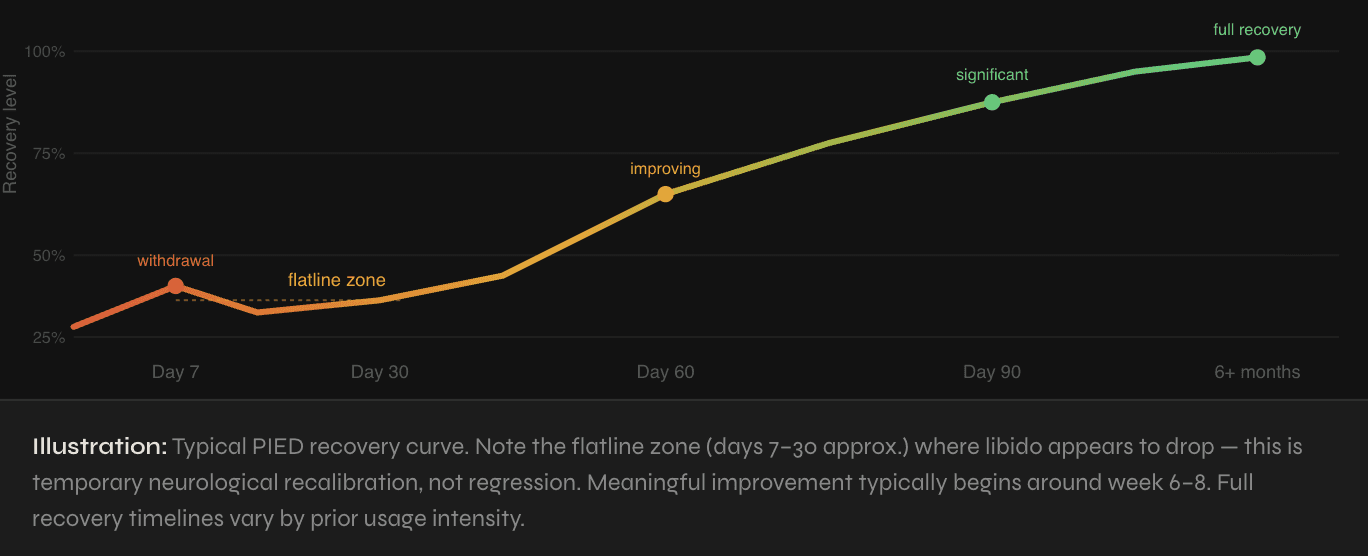
W1: Days 1–7 · Withdrawal phase
Strong cravings, irritability, restlessness
The brain's dopamine system is aggressively demanding what it's become accustomed to. Expect mood swings, difficulty concentrating, sleep disruption, and intense urges. This is the hardest window. Don't give in here.
FL: Days 7–30 · The flatline
Low libido, emotional numbness — this is NOT permanent
Many men panic during the flatline because their sex drive seems to disappear entirely. Morning erections may stop. Desire flatlines. This is the brain's recalibration phase — it's shutting down the overstimulated system to rebuild it at baseline sensitivity. It passes. Do not use this as an excuse to relapse.
M2: Days 30–60 · Early recovery
Libido returning, morning erections resuming
This is where most men begin noticing genuine improvement. Morning erections return. Real-world attraction starts feeling more natural. Urges to watch porn soften. Energy and mood begin stabilizing. For men with lighter usage histories, some are fully recovered by this point.
90: Days 60–90 · Significant recovery
Most men report meaningful restoration of function
By the 90-day mark, the majority of men report substantial improvement in erectile function with real partners. Confidence returns. Intimacy feels natural again. For many, this is the turning point where recovery becomes self-sustaining.
6M: 6+ months · Full recovery
Sustained, reliable function — for nearly all men
For men with severe or long-term PIED, full recovery may take 6–18 months. Recovery time correlates strongly with how long and heavily you used porn, and how early you started. But the clinical data is clear: PIED is reversible in the vast majority of cases.
📄Research Citation
A series of clinical case reports compiled by urologist and sex researcher Dr. Michael Kasain documented 20 men under 40 with PIED. After voluntarily eliminating pornography for 3–6 months, all 20 reported significant or complete restoration of erectile function without pharmacological intervention. None had underlying organic pathology.
Kasain, M.A. (2016). Eliminating pornography restores sexual function in men with PIED: A case series. Journal of Sexual Medicine, 13(4).
How to Actually Reverse PIED: Your Action Plan
Recovery from PIED is not mysterious. It follows one core principle: remove the overstimulation and let neuroplasticity do its job. Here's exactly what that looks like in practice.
Step 1: Stop all pornography — completely
Not "cutting back." Not "switching to milder content." Total elimination. This is non-negotiable. The brain cannot recalibrate while the conditioning stimulus is still present. Even occasional use resets the neurological clock significantly.
✓ What this means in practice
Install a hard-to-remove porn blocker on every device. Have someone you trust set the password. Remove saved content, delete bookmarks, unfollow triggering accounts on social media. Make access genuinely difficult — not just inconvenient.
Step 2: Consider a "reboot" — a period of no sexual stimulation at all
Many men with PIED benefit from a total reset: no porn, no masturbation, no orgasm for 30–90 days. This is sometimes called "monk mode." The idea is to give the dopamine system complete rest — no stimulation of any kind — so receptor sensitivity can recover faster.
This is not about abstinence as a moral stance. It's about giving an overstimulated system time to heal. Think of it like resting an injured muscle.
Step 3: Address performance anxiety as a separate layer
Once PIED has caused a few failed sexual encounters, performance anxiety begins to layer on top. Anxiety triggers the sympathetic nervous system (fight-or-flight), which actively suppresses the parasympathetic response needed for erections. Anxiety about erections causes the very thing you're afraid of.
Breaking this cycle requires:
Communicating openly with your partner (shame and secrecy make anxiety worse)
Non-goal-oriented physical intimacy during recovery — touch without performance pressure
Cognitive behavioral therapy (CBT) specifically targeting sexual performance anxiety
Mindfulness practices that reduce the hypervigilant monitoring of physical response
Step 4: Support neuroplasticity with lifestyle changes
The brain rewires faster when given the right conditions. These aren't optional nice-to-haves — they meaningfully accelerate recovery:
📄Research Citation
A 2016 study by researchers at the Max Planck Institute found that regular aerobic exercise increases the density of dopamine D2 receptors in the striatum — the precise mechanism that pornography downregulates. Exercise was found to be one of the most effective non-pharmacological methods for restoring dopamine system health after chronic overstimulation.
Hötting, K. & Röder, B. (2013). Beneficial effects of physical exercise on neuroplasticity and cognition. Neuroscience & Biobehavioral Reviews.
Step 5: Should you use medication like Viagra or Cialis?
This is a common question, and the answer is nuanced. Erectile medications do not treat PIED. They work by increasing blood flow, but PIED's root cause is neurological, not vascular. Medication can provide temporary function, but it does not fix the underlying desensitization.
Some therapists recommend using medication during recovery as a confidence bridge — to allow positive sexual experiences while the dopamine system heals. This can reduce performance anxiety. But it should be used strategically and temporarily, not as a permanent solution, and only under medical guidance.
Medication treats the symptom. Quitting porn treats the cause. Do not confuse them.
— Adapted from clinical guidance, Urology Care Foundation
Frequently Asked Questions
How do I know if my ED is PIED or something else?
The clearest marker: if you get full, reliable erections with pornography but not with a real partner, PIED is the most likely explanation. Organic ED (cardiovascular, hormonal) tends to affect all erections, including morning erections and those during porn. See a doctor to rule out physical causes, but if you get normal erections with porn, the cause is almost certainly neurological, not anatomical.
Can PIED be fully reversed?
Yes — in the vast majority of cases. The brain's neuroplasticity allows dopamine receptor density and sensitivity to recover once the overstimulation is removed. The key variable is time. Men with longer and heavier usage histories take longer to recover, but full recovery is documented across hundreds of case reports and thousands of community testimonials.
What if I relapse during recovery?
Relapses do reset progress — particularly if they involve binge watching. But the brain does not return to square one instantly. Think of recovery like a savings account; a withdrawal hurts, but you've still built equity. The research on behavioral addiction consistently shows that persistence through multiple relapses is the norm before achieving long-term recovery. Don't use relapse as a reason to quit. Use it as data.
Is PIED real? My doctor hasn't heard of it.
This is a common frustration. PIED is not yet in medical diagnostic manuals as a formal diagnosis, partly because the research is recent and partly due to the sensitive political nature of pornography research. However, the neuroscientific mechanisms are well-established — dopamine downregulation, reward pathway conditioning, and desensitization are not controversial. Most urologists and sex therapists who work with young men now recognize the pattern, even if the official terminology varies.
Does age affect recovery time?
Younger men generally recover faster due to higher neuroplasticity. However, men who started using porn very early (adolescence) may have more deeply conditioned responses, which can extend recovery. Conversely, men who started using later in life but intensively may recover faster despite older age. The dominant factor is duration and intensity of use, not age alone.
YOUR BRAIN CAN HEAL.
PIED is reversible. The science is clear. The only question is whether you're willing to stop.
What Exactly Is PIED? And Why Is No One Talking About It?
Let's start with the uncomfortable truth: erectile dysfunction in young, healthy men has exploded over the last two decades. And the timeline lines up almost perfectly with the mainstream adoption of high-speed internet and free streaming porn.
PIED; Porn-Induced Erectile Dysfunction — is a condition where a man can get and maintain an erection while watching pornography, but struggles or fails to do so during real sexual encounters with a partner. It's not a blood flow problem. It's not hormonal. It's not aging. It's neurological and it's driven by how the brain responds to superstimulation.
📄Research Citation
A 2014 study published in Psychology Today and widely cited in urology literature found that rates of sexual dysfunction in men aged 18–40 had risen dramatically since the early 2000s, with researchers explicitly linking increased pornography consumption to symptoms of sexual arousal disorder and erectile dysfunction in otherwise healthy young men.
Bronner, G. & Ben-Zion, I.Z. (2014). Unusual masturbatory practice as an etiological factor in the diagnosis and treatment of sexual dysfunction in young men. Journal of Sexual Medicine.
Before the internet, erectile dysfunction in men under 40 was so rare it was barely studied. Today it fills urology waiting rooms. And while the medical community has been slow to name porn as a cause, the neuroscience has been catching up fast.
The brain doesn't know the difference between pixels and a real partner. It just knows what level of stimulation it has been conditioned to expect.
— Gary Wilson, author of "Your Brain on Porn" (2014)
The Brain Science Behind PIED — Explained Simply
This is the part most articles skip, so let's actually go through it. Understanding the mechanism is what makes recovery feel logical instead of hopeful.
The dopamine system: your brain's reward engine
Dopamine is not the "pleasure" chemical — that's a common misconception. Dopamine is the "wanting" chemical. It drives motivation, craving, and pursuit. You get a hit of dopamine in anticipation of a reward, not just during it.
During sexual activity — real or pornographic — the brain releases dopamine, along with opioids (for pleasure) and oxytocin (for bonding). This system evolved to motivate us toward sex and reproduction. It works beautifully in a natural context.
Pornography hijacks this system by providing something no natural environment ever could: infinite novelty, zero rejection, and escalating stimulation on demand.
What downregulation actually means
When your brain is flooded with dopamine repeatedly — through porn — it protects itself by reducing the number and sensitivity of dopamine receptors. This is called downregulation. The same mechanism that causes drug tolerance.
The consequence: your dopamine system now requires more stimulation to produce the same response. Normal stimuli — including a real, attractive partner — no longer clear the activation threshold needed to trigger and maintain an erection.
Meanwhile, porn — with its novelty, extremity, and variety — still does. This is why men with PIED can often masturbate perfectly well to pornography but fail with a real partner. It's not anxiety (though anxiety can compound it). It's a conditioned neurological response.
📄Research Citation
Cambridge University researchers (Voon et al., 2014) used fMRI brain imaging to compare compulsive pornography users to non-users. They found that the same brain regions activated by drug cues in addicts — the ventral striatum, anterior cingulate cortex, and amygdala — were activated by pornographic imagery in heavy porn users. The patterns were nearly identical to cocaine addiction responses.
Voon, V. et al. (2014). Neural correlates of sexual cue reactivity in individuals with and without compulsive sexual behaviours. PLOS ONE, 9(7).
📄Research Citation
A 2016 review in Behavioral Sciences by researchers Hilton and Watts documented that excessive pornography use causes measurable brain changes consistent with other addictive disorders, including hypofrontality (reduced activity in the prefrontal cortex, responsible for impulse control) and altered dopamine signaling in the reward pathways.
Hilton, D.L. & Watts, C. (2011). Pornography addiction: A neuroscience perspective. Surgical Neurology International, 2(1), 19.
Signs You Might Have PIED — Be Honest With Yourself
PIED exists on a spectrum. Here are the most telling indicators — ranging from early warning signs to full-blown PIED.
01. You need porn (or porn fantasy) to finish during sex
You're physically present with a real partner, but mentally you've retreated to pornographic imagery to maintain arousal or reach orgasm. This is one of the earliest signs of desensitization.
02. Death grip and escalation dependency
You've conditioned yourself to a specific type and intensity of stimulation — often a very tight grip during masturbation — that no real encounter can replicate. You also find yourself seeking more extreme content to feel the same response.
03. Erections with porn, problems without it
The clearest diagnostic sign. You have no physical difficulty achieving erections during pornography use, but struggle or fail during real intimacy. If this is you, PIED is the most likely explanation — not cardiovascular issues, not low testosterone.
⚠ Important note
PIED symptoms can overlap with other causes of erectile dysfunction — including low testosterone, cardiovascular disease, diabetes, and certain medications. If you're unsure, see a doctor to rule out physical causes first. If you get full erections with porn but not with partners, PIED is the overwhelmingly likely explanation.
The PIED Recovery Timeline: What to Actually Expect
Recovery from PIED is real and well-documented — but it is not fast, and it is not linear. Here's a realistic breakdown of what most men experience when they stop using porn.
W1: Days 1–7 · Withdrawal phase
Strong cravings, irritability, restlessness
The brain's dopamine system is aggressively demanding what it's become accustomed to. Expect mood swings, difficulty concentrating, sleep disruption, and intense urges. This is the hardest window. Don't give in here.
FL: Days 7–30 · The flatline
Low libido, emotional numbness — this is NOT permanent
Many men panic during the flatline because their sex drive seems to disappear entirely. Morning erections may stop. Desire flatlines. This is the brain's recalibration phase — it's shutting down the overstimulated system to rebuild it at baseline sensitivity. It passes. Do not use this as an excuse to relapse.
M2: Days 30–60 · Early recovery
Libido returning, morning erections resuming
This is where most men begin noticing genuine improvement. Morning erections return. Real-world attraction starts feeling more natural. Urges to watch porn soften. Energy and mood begin stabilizing. For men with lighter usage histories, some are fully recovered by this point.
90: Days 60–90 · Significant recovery
Most men report meaningful restoration of function
By the 90-day mark, the majority of men report substantial improvement in erectile function with real partners. Confidence returns. Intimacy feels natural again. For many, this is the turning point where recovery becomes self-sustaining.
6M: 6+ months · Full recovery
Sustained, reliable function — for nearly all men
For men with severe or long-term PIED, full recovery may take 6–18 months. Recovery time correlates strongly with how long and heavily you used porn, and how early you started. But the clinical data is clear: PIED is reversible in the vast majority of cases.
📄Research Citation
A series of clinical case reports compiled by urologist and sex researcher Dr. Michael Kasain documented 20 men under 40 with PIED. After voluntarily eliminating pornography for 3–6 months, all 20 reported significant or complete restoration of erectile function without pharmacological intervention. None had underlying organic pathology.
Kasain, M.A. (2016). Eliminating pornography restores sexual function in men with PIED: A case series. Journal of Sexual Medicine, 13(4).
How to Actually Reverse PIED: Your Action Plan
Recovery from PIED is not mysterious. It follows one core principle: remove the overstimulation and let neuroplasticity do its job. Here's exactly what that looks like in practice.
Step 1: Stop all pornography — completely
Not "cutting back." Not "switching to milder content." Total elimination. This is non-negotiable. The brain cannot recalibrate while the conditioning stimulus is still present. Even occasional use resets the neurological clock significantly.
✓ What this means in practice
Install a hard-to-remove porn blocker on every device. Have someone you trust set the password. Remove saved content, delete bookmarks, unfollow triggering accounts on social media. Make access genuinely difficult — not just inconvenient.
Step 2: Consider a "reboot" — a period of no sexual stimulation at all
Many men with PIED benefit from a total reset: no porn, no masturbation, no orgasm for 30–90 days. This is sometimes called "monk mode." The idea is to give the dopamine system complete rest — no stimulation of any kind — so receptor sensitivity can recover faster.
This is not about abstinence as a moral stance. It's about giving an overstimulated system time to heal. Think of it like resting an injured muscle.
Step 3: Address performance anxiety as a separate layer
Once PIED has caused a few failed sexual encounters, performance anxiety begins to layer on top. Anxiety triggers the sympathetic nervous system (fight-or-flight), which actively suppresses the parasympathetic response needed for erections. Anxiety about erections causes the very thing you're afraid of.
Breaking this cycle requires:
Communicating openly with your partner (shame and secrecy make anxiety worse)
Non-goal-oriented physical intimacy during recovery — touch without performance pressure
Cognitive behavioral therapy (CBT) specifically targeting sexual performance anxiety
Mindfulness practices that reduce the hypervigilant monitoring of physical response
Step 4: Support neuroplasticity with lifestyle changes
The brain rewires faster when given the right conditions. These aren't optional nice-to-haves — they meaningfully accelerate recovery:
📄Research Citation
A 2016 study by researchers at the Max Planck Institute found that regular aerobic exercise increases the density of dopamine D2 receptors in the striatum — the precise mechanism that pornography downregulates. Exercise was found to be one of the most effective non-pharmacological methods for restoring dopamine system health after chronic overstimulation.
Hötting, K. & Röder, B. (2013). Beneficial effects of physical exercise on neuroplasticity and cognition. Neuroscience & Biobehavioral Reviews.
Step 5: Should you use medication like Viagra or Cialis?
This is a common question, and the answer is nuanced. Erectile medications do not treat PIED. They work by increasing blood flow, but PIED's root cause is neurological, not vascular. Medication can provide temporary function, but it does not fix the underlying desensitization.
Some therapists recommend using medication during recovery as a confidence bridge — to allow positive sexual experiences while the dopamine system heals. This can reduce performance anxiety. But it should be used strategically and temporarily, not as a permanent solution, and only under medical guidance.
Medication treats the symptom. Quitting porn treats the cause. Do not confuse them.
— Adapted from clinical guidance, Urology Care Foundation
Frequently Asked Questions
How do I know if my ED is PIED or something else?
The clearest marker: if you get full, reliable erections with pornography but not with a real partner, PIED is the most likely explanation. Organic ED (cardiovascular, hormonal) tends to affect all erections, including morning erections and those during porn. See a doctor to rule out physical causes, but if you get normal erections with porn, the cause is almost certainly neurological, not anatomical.
Can PIED be fully reversed?
Yes — in the vast majority of cases. The brain's neuroplasticity allows dopamine receptor density and sensitivity to recover once the overstimulation is removed. The key variable is time. Men with longer and heavier usage histories take longer to recover, but full recovery is documented across hundreds of case reports and thousands of community testimonials.
What if I relapse during recovery?
Relapses do reset progress — particularly if they involve binge watching. But the brain does not return to square one instantly. Think of recovery like a savings account; a withdrawal hurts, but you've still built equity. The research on behavioral addiction consistently shows that persistence through multiple relapses is the norm before achieving long-term recovery. Don't use relapse as a reason to quit. Use it as data.
Is PIED real? My doctor hasn't heard of it.
This is a common frustration. PIED is not yet in medical diagnostic manuals as a formal diagnosis, partly because the research is recent and partly due to the sensitive political nature of pornography research. However, the neuroscientific mechanisms are well-established — dopamine downregulation, reward pathway conditioning, and desensitization are not controversial. Most urologists and sex therapists who work with young men now recognize the pattern, even if the official terminology varies.
Does age affect recovery time?
Younger men generally recover faster due to higher neuroplasticity. However, men who started using porn very early (adolescence) may have more deeply conditioned responses, which can extend recovery. Conversely, men who started using later in life but intensively may recover faster despite older age. The dominant factor is duration and intensity of use, not age alone.
YOUR BRAIN CAN HEAL.
PIED is reversible. The science is clear. The only question is whether you're willing to stop.
Learn more
Discover more from the latest posts.